
Crypto Payments in Restaurants: A 2026 Owner's Guide


TL;DR:
Cryptocurrency payments offer restaurants lower fees, faster settlement, and operational savings that boost margins.
Implementing crypto solutions also enhances speed at checkouts while eliminating chargeback risks and attracting tech-savvy customers.
Adopting stablecoins and pilot programs help manage volatility and refine process integration for long-term benefits.
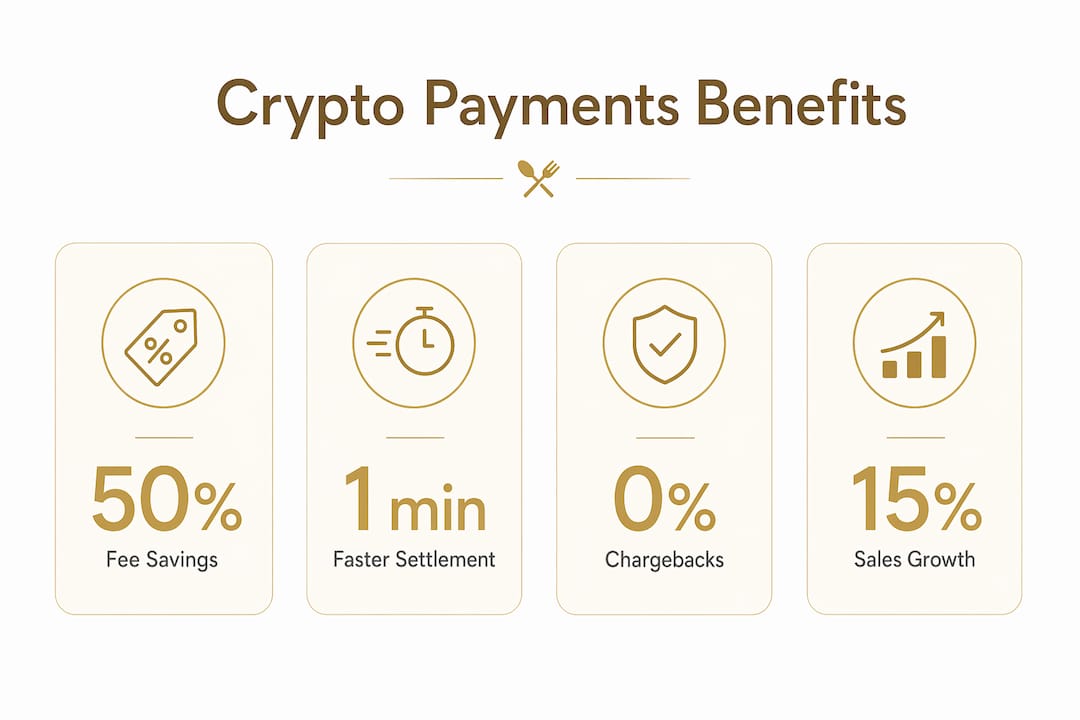
Cryptocurrency payment integration is defined as the direct acceptance of digital currencies like Bitcoin, Ethereum, or stablecoins at the point of sale, bypassing traditional card networks entirely. The role of crypto payments in restaurants goes far beyond novelty. Steak 'n Shake demonstrated this clearly when its Bitcoin Lightning adoption contributed to 15% same-store sales growth in Q3 2025 and 18% growth into early 2026. That performance signals a structural shift, not a trend. When accepting cryptocurrency in dining translates directly into lower fees, faster settlements, and reinvested savings, it becomes a financial strategy worth taking seriously.
What financial advantages do cryptocurrency payments offer restaurants?
Traditional credit card processing fees run between 2.5% and 3.5% per transaction, and that figure does not include chargeback penalties or monthly gateway fees. For a restaurant turning $2 million annually, that means up to $70,000 disappearing into payment infrastructure before a single dollar reaches operations. The impact compounds fast.
Crypto payment gateways, by contrast, charge fees between 0.5% and 1%, with Lightning Network transactions settling in sub-second time at fees under 0.1%. That is not a marginal improvement. It is a category difference. Steak 'n Shake’s projected savings from switching customers to Bitcoin Lightning payments reach approximately $6 million annually, a figure that reframes the entire conversation about payment infrastructure.
Settlement speed matters just as much as fee reduction. Standard card payments hold funds for 24 to 48 hours before clearing. Crypto payments deliver near-instant settlement, which improves daily cash flow and removes the uncertainty of multi-day banking cycles. For operators managing tight margins, that liquidity difference is real money.
One critical distinction: true fee savings only materialize when payments bypass Visa and Mastercard rails entirely. Crypto-branded debit cards that still route through traditional networks deliver no cost advantage to the merchant. Direct Lightning payments or stablecoin transfers are the mechanisms that actually move the needle.
Payment Method | Processing Fee | Settlement Time | Chargeback Risk |
Credit card (Visa/Mastercard) | 2.5% to 3.5% | 24 to 48 hours | High |
Crypto gateway (standard) | 0.5% to 1% | Minutes | None |
Lightning Network (Bitcoin) | Under 0.1% | Sub-second | None |
Stablecoin (USDC/USDT) | 0.5% to 1% | Minutes | None |
Pro Tip: When evaluating the benefits of crypto payments, calculate your current annual card processing spend first. Multiply your revenue by 3% to get a baseline. That number is what crypto adoption puts back on the table.
How does accepting cryptocurrency affect restaurant operations?
Speed at the point of sale is where the impact of crypto on restaurants becomes tangible for front-line staff. Lightning Network payments confirm before order delivery, which removes the friction of card authorization delays during peak service. Faster payment confirmation means faster table turns and shorter queues at self-service windows.

The elimination of chargebacks deserves particular attention. Credit card chargebacks cost U.S. restaurants time, administrative effort, and direct revenue loss. Crypto transactions are irreversible by design, which means a confirmed payment stays confirmed. That certainty removes an entire category of operational risk that most restaurant managers accept as unavoidable.
Steak 'n Shake took the reinvestment logic further than most. The company built a closed-loop Bitcoin reserve that funds employee bonuses at $0.21 per hour worked in Bitcoin, while also directing savings toward menu quality upgrades. That model treats crypto not as a payment curiosity but as a treasury and incentive tool. It connects payment infrastructure directly to staff motivation and product quality.
Practical operational benefits for restaurant owners considering this path include:
Faster checkout flow at self-service kiosks and counters, reducing wait times during peak hours
Zero chargeback exposure, eliminating disputed transaction management and associated fees
Improved daily cash position through instant settlement rather than multi-day banking holds
Marketing differentiation by attracting tech-forward customers who actively seek crypto-friendly venues
Employee incentive programs funded directly from payment savings, as demonstrated by Steak 'n Shake
Pro Tip: Integrate your crypto payment terminal with your existing POS display so staff see a single confirmed screen. Removing the need to cross-reference two systems cuts service time and training friction.
What are the challenges of managing crypto volatility in restaurants?
Price volatility is the objection most restaurant managers raise first, and it is a legitimate concern. Bitcoin’s value can swing 5% to 10% in a single day, which creates real risk if a restaurant holds received payments in raw cryptocurrency. The answer is not to avoid crypto. The answer is to accept it intelligently.
Stablecoins like USDC and USDT peg their value to the U.S. dollar, preserving the exact payment amount received regardless of broader market movement. Accepting stablecoins gives restaurants the fee and settlement advantages of blockchain payments without exposure to Bitcoin price swings. For day-to-day restaurant transactions, stablecoins offer the best practical balance.
For restaurants that want Bitcoin exposure, automatic conversion tools solve the volatility problem at the gateway level. Platforms like BitPay and Strike offer instant conversion to USD at the moment of transaction, locking in the dollar value before any price movement occurs. The restaurant receives dollars in its bank account while the customer pays in Bitcoin.
Risk management strategies worth building into your crypto payment policy:
Accept stablecoins first (USDC, USDT) to eliminate volatility entirely before adding Bitcoin
Use non-custodial gateways so you hold private keys directly with no intermediary controlling your funds
Enable auto-conversion at the gateway level to lock in USD value at transaction time
Run a pilot program at one location before chain-wide rollout, as industry guidance recommends a measured approach to test customer demand
Document your tax treatment of crypto receipts from day one, since the IRS treats cryptocurrency as property
A pilot-first approach allows you to collect real transaction data, measure customer uptake, and refine internal policies before committing to full-scale adoption. It also gives your accounting team time to build the right reporting workflows.
How can restaurant owners implement cryptocurrency payment solutions?
Implementation does not require a technical background. The modern cryptocurrency payment solutions available to restaurants in 2026 are designed for operators, not developers. The core decision is choosing between custodial and non-custodial gateways.
A non-custodial gateway gives you direct control of received funds. No third party can freeze your account or delay withdrawals. Aurpay operates on this model and supports Bitcoin, Ethereum, and multiple stablecoins with QR code payment generation that works at any counter. BitPay offers a custodial model with strong POS integrations and optional USD conversion. Strike specializes in Lightning Network payments and is particularly well-suited for fast-casual and quick-service formats where speed matters most.
The practical steps to get started follow a clear sequence:
Choose your gateway based on whether you want direct custody (Aurpay) or managed conversion (BitPay, Strike)
Select which currencies to accept starting with Bitcoin via Lightning and at least one stablecoin
Integrate with your POS using available plugins or hosted checkout pages that generate QR codes
Set up a secure wallet with hardware backup for any funds you plan to hold rather than convert
Train front-line staff on the payment confirmation screen so they recognize a completed transaction
Launch a pilot at your highest-volume location and track transaction volume weekly for 60 days
Gateway | Fee Model | Settlement | Best For |
Aurpay | 0.5% to 1% | Direct to wallet | Non-custodial control |
BitPay | 1% | USD conversion available | POS integration |
Strike | Near zero (Lightning) | Instant | Fast-casual speed |
For a broader view of how crypto fits within your full payment options strategy, comparing all available methods helps you build a payment mix that serves every customer segment.
How does crypto fit into the broader digital transformation of restaurants?
Cryptocurrency acceptance does not exist in isolation. It works best when it sits inside a broader digital infrastructure that includes digital menus, contactless ordering, and loyalty programs. The savings generated from lower processing fees become the fuel for those other investments.
A restaurant that cuts $30,000 annually in card fees has a concrete budget for upgrading its ordering technology, improving its menu presentation, or launching a digital loyalty program. That reinvestment loop is what separates restaurants treating crypto as a payment experiment from those treating it as a core business driver. The Steak 'n Shake model proves the loop works at scale.
Digital tools that complement crypto payment adoption and amplify its impact include:
QR code menus that allow customers to browse, order, and pay from their own device, creating a fully contactless flow
Tablet and iPad menus that present high-quality food visuals and influence order value before payment
Digital loyalty programs that reward repeat visits and can be funded partly from payment savings
Online ordering systems that accept crypto at checkout, extending the payment option beyond the physical dining room
CRM integration that captures guest data from digital interactions and enables targeted marketing
Restaurants that digitalize operations across ordering, payment, and loyalty simultaneously see compounding efficiency gains. Each system reinforces the others. A customer who orders via QR code and pays in Bitcoin completes a transaction with zero paper, zero card swipe, and zero chargeback risk. That is the operational ideal that forward-thinking restaurant owners are building toward in 2026.
Early adoption also carries a marketing advantage that diminishes over time. Restaurants that accept crypto today position themselves as forward-thinking venues in a market where most competitors still rely entirely on card infrastructure. That positioning attracts a specific, high-value customer segment that spends deliberately and shares experiences online.
Key takeaways
Crypto payments in restaurants reduce processing fees by up to 50%, eliminate chargebacks, and generate reinvestable savings that fund staff incentives, menu upgrades, and broader digital transformation.
Point | Details |
Fee reduction is substantial | Crypto gateways charge 0.5% to 1% versus 2.5% to 3.5% for credit cards, saving thousands annually. |
Lightning Network leads on speed | Sub-second settlement eliminates card authorization delays and improves peak-hour service flow. |
Stablecoins solve volatility | Accepting USDC or USDT preserves dollar value without exposure to Bitcoin price swings. |
Pilot programs reduce risk | Starting at one location lets you measure demand and refine policy before full rollout. |
Savings fund reinvestment | Steak 'n Shake’s model shows crypto fee savings can directly fund employee bonuses and food quality upgrades. |
Why I think most restaurants are still thinking about crypto payments the wrong way
By Abhi
Most of the restaurant owners I speak with frame crypto payments as a customer-facing feature, something to offer tech-savvy diners who happen to carry Bitcoin. That framing undersells the opportunity by an order of magnitude.
The real story is on the cost side. When you look at what Steak 'n Shake has built, the customer-facing payment option is almost secondary to the treasury strategy underneath it. They are holding Bitcoin on the balance sheet, funding employee bonuses from it, and using fee savings to upgrade the product. That is a fundamentally different relationship with payment infrastructure than most restaurant operators have ever considered.
What I find most compelling is how this connects to the broader restaurant digitization checklist that forward-thinking operators are already working through. Crypto payments are not a standalone decision. They are one node in a digital ecosystem that includes ordering, loyalty, and menu technology. When all those nodes connect, the compounding effect on margins and customer experience is genuinely transformative.
My honest advice: stop waiting for crypto to become mainstream before you act. The fee savings are real today. The operational benefits are proven today. The restaurants that treat this as a core financial strategy rather than a marketing experiment will look back on 2026 as the year they got ahead.
— Abhi
Transform your restaurant with digital menus and crypto-ready ordering
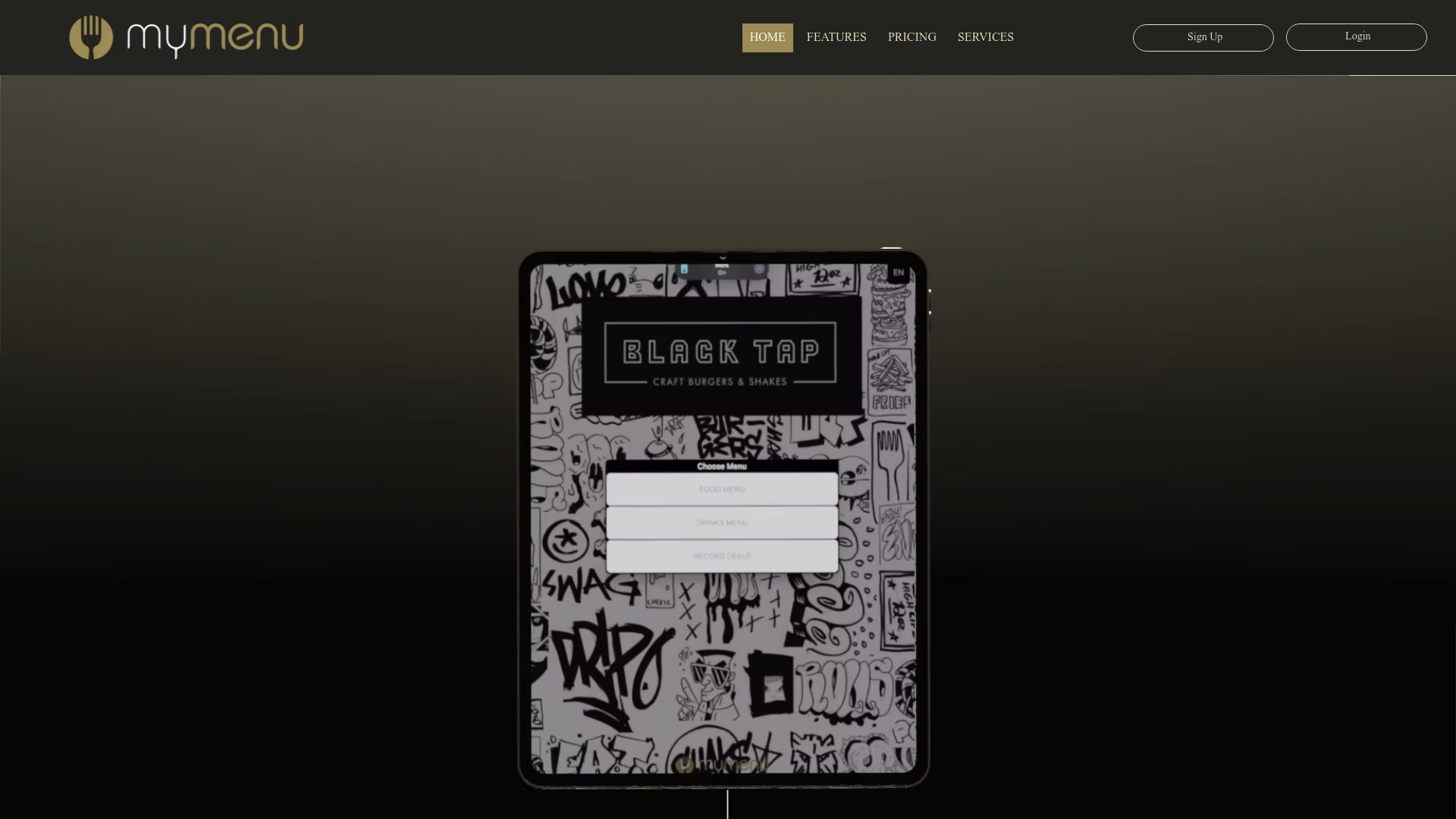
Mydigimenu gives restaurant owners the digital infrastructure that makes crypto payment adoption feel natural rather than bolted on. The platform’s digital tablet and iPad menus present your menu with high-quality visuals, support multiple payment options including cryptocurrencies, and integrate with your existing POS without requiring app downloads from your guests. Pair that with Mydigimenu’s QR code menu for fully contactless ordering and payment, and you have a guest experience that matches the speed and efficiency that crypto payments deliver at the back end. Explore plans and pricing and see how quickly the investment pays for itself.
FAQ
What is the role of crypto payments in restaurants?
Crypto payments in restaurants reduce transaction processing fees from the typical 2.5% to 3.5% range down to 0.5% or lower, eliminate chargebacks, and enable instant settlement. They also create reinvestable savings that operators can direct toward staff incentives and operational improvements.
How do restaurants use crypto without volatility risk?
Restaurants accept stablecoins like USDC or USDT, which peg to the U.S. dollar, or use gateways like BitPay and Strike that auto-convert Bitcoin to USD at the moment of transaction. Both approaches preserve dollar value regardless of market movement.
Which crypto payment processors work best for restaurants?
Aurpay suits operators who want non-custodial control of funds. BitPay offers strong POS integration with optional USD conversion. Strike is the best fit for fast-casual formats that prioritize Lightning Network speed and near-zero fees.
Do crypto payments actually increase restaurant sales?
Steak 'n Shake reported 15% same-store sales growth in Q3 2025 after adopting Bitcoin payments, with growth accelerating to 18% in early 2026. The growth reflects both operational savings reinvested into product quality and the marketing advantage of early crypto adoption.
How should a restaurant start accepting cryptocurrency?
Begin with a pilot at one location, accept stablecoins first to avoid volatility, and use a non-custodial gateway for direct fund control. Track transaction volume for 60 days before deciding on a full rollout.
Recommended
Comments