
Best DSMenu Alternatives for Restaurants in 2026


Hospitality managers searching for DSMenu alternatives have six strong contenders worth serious consideration: Fugo, OSM Solutions, Digital Menu Box, Eyeconic.TV, Push Operations, and Mydigimenu. Each platform takes a different angle on the same core challenge — getting the right menu content in front of guests at the right moment, without the friction of printed boards or manual updates. The decision ultimately comes down to how deeply a platform connects with your POS, how well it handles multi-location signage, and whether its pricing model fits your operation’s scale.
Table of Contents
What are the best DSMenu alternatives for hospitality businesses?
The top DSMenu alternatives span two distinct categories: dedicated digital signage platforms and broader hospitality management tools with menu capabilities built in. Knowing which category fits your operation is the first filter.
Fugo — Best for teams that want cloud-based digital signage with a clean content management interface. Fugo suits multi-screen deployments where marketing and operations teams share control of display content.
OSM Solutions — Designed for operators who need a full-service approach to digital menu boards, including hardware procurement and ongoing content support. A practical fit for independent restaurants without in-house tech staff.
Digital Menu Box — Focused squarely on front-of-house menu display, with templates built for quick-service and fast-casual formats. Setup is fast, and the learning curve is minimal.
Eyeconic.TV — Positions itself at the intersection of digital signage and ad-tech, making it attractive for venues that want to monetize screen space alongside menu display.
Push Operations — Broader in scope than the others, covering workforce management alongside menu and POS features. Useful for operators who want labor scheduling and menu control under one roof.
Mydigimenu — The most hospitality-native option on this list, built specifically for restaurants, cafes, bars, and hotels. It covers contactless digital menus, QR code ordering, CRM, loyalty programs, and POS integration in a single platform.
POS integration and signage capabilities are the two criteria that separate genuinely useful platforms from those that look good in a demo but create operational headaches at scale.
How do these platforms compare on features, pricing, and support?
Customer support quality and POS compatibility vary widely across these platforms, and those gaps show up fast once you’re live. Compatibility with your existing POS hardware directly shapes how smoothly deployment goes and how much manual work your team absorbs afterward.

Platform | Best for | Feature set | POS integration | Signage capabilities | Pricing model | Support quality |
Fugo | Multi-screen cloud signage | Content scheduling, playlists, templates | Limited native POS; API-dependent | Strong multi-display support | Subscription per screen | Online support; community resources |
OSM Solutions | Full-service menu board setup | Managed content, hardware bundling | Varies by deployment | Good for static and dynamic boards | Custom/project-based | Dedicated account management |
Digital Menu Box | Quick-service menu display | Template-driven menu boards | Basic POS data pull | Single and multi-screen | Tiered subscription | Email and chat support |
Eyeconic.TV | Signage with ad monetization | Ad scheduling, menu display, analytics | Moderate; depends on POS type | Advanced display zone management | Tiered or custom | Standard business hours support |
Push Operations | Workforce and menu management | Labor scheduling, menu control, reporting | Moderate POS integration | Basic digital menu display | Per-location subscription | Phone and email; onboarding included |
Mydigimenu | Full hospitality digital experience | QR menus, tablet menus, CRM, loyalty, payments | Third-party POS and delivery platforms | Rich multimedia, customizable layouts | Tiered plans; view pricing | Multilingual support; onboarding assistance |
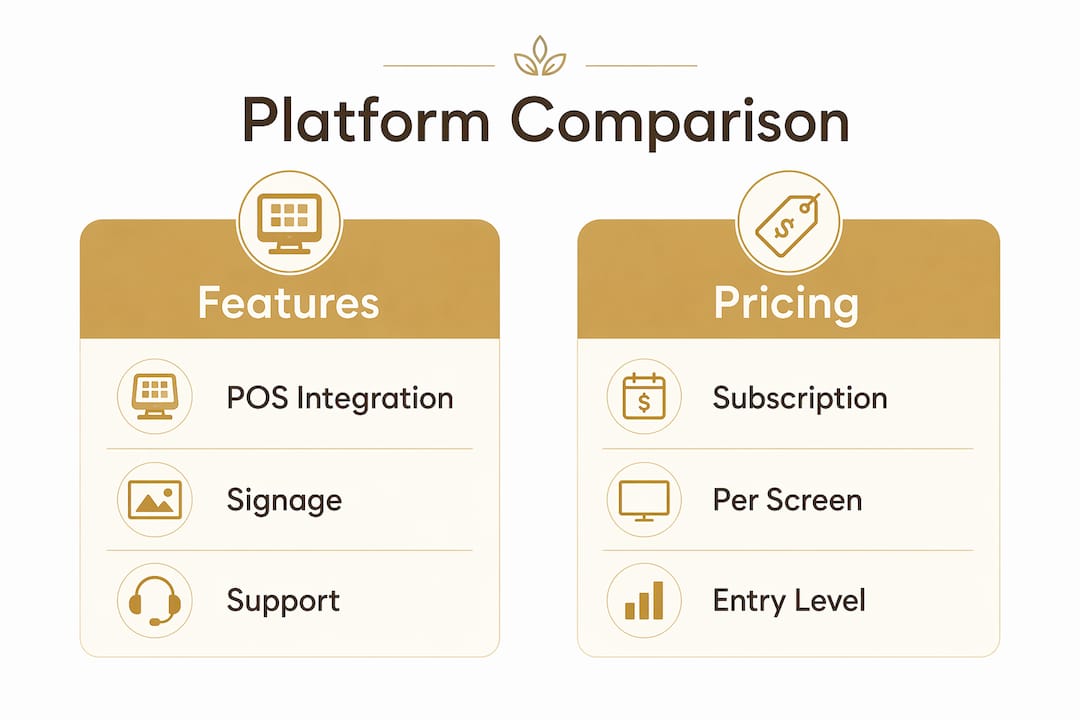
Pricing across these platforms generally follows a per-screen or per-location subscription model, with entry-level tiers available and scaling with feature depth. Trial availability differs: some platforms offer free demos on request, while others provide limited free tiers. Always verify trial terms before committing, since onboarding time is a real cost even when the software itself is free to test.
Scalability is another dividing line. Platforms built for single-location operators often struggle when a brand expands to five or ten sites. Mydigimenu’s multilingual and multi-currency support gives it a natural edge for groups with international locations or diverse guest demographics.
How to choose the right digital menu board software for your venue
Choosing well means matching the platform’s architecture to your actual operational workflow, not just its feature checklist.
POS integration depth — Confirm whether the platform connects natively to your POS or requires a middleware layer. Native integrations update menu prices and item availability in real time; middleware solutions introduce lag and potential sync errors.
Signage flexibility — Assess whether the platform supports the display types you use or plan to use: wall-mounted screens, tablet menus, drive-thru boards, or QR code landing pages. A platform that handles only one format will limit you as your operation grows.
Pricing transparency — Platforms that publish clear per-screen or per-location pricing are easier to budget for. Watch for per-feature add-ons that inflate the base price once you need core capabilities like scheduling or analytics.
Customer support responsiveness — Reviews consistently flag responsive onboarding support as a decisive factor. Ask vendors specifically about response times and whether onboarding assistance is included or billed separately.
Platform scalability — If you manage or plan to manage multiple locations, centralized control is non-negotiable. A single dashboard that pushes updates across all screens simultaneously eliminates the manual update errors that erode consistency.
Pro Tip: Automated dayparting and location-specific pricing are among the highest-impact features in digital menu board software. Automated pricing triggers tied to time of day and location correlate with measurable average ticket size improvements, and they remove the manual update burden that causes pricing errors across multi-site operations. Prioritize platforms that offer these features natively rather than as expensive add-ons.
Request a live demo with your actual POS system connected before signing any contract. A demo using sample data tells you very little about real-world performance. Pairing your digital menu platform with strong restaurant SEO strategies also amplifies the guest acquisition side of the equation, turning better in-venue experiences into stronger online visibility.
Mydigimenu brings the full hospitality digital experience together
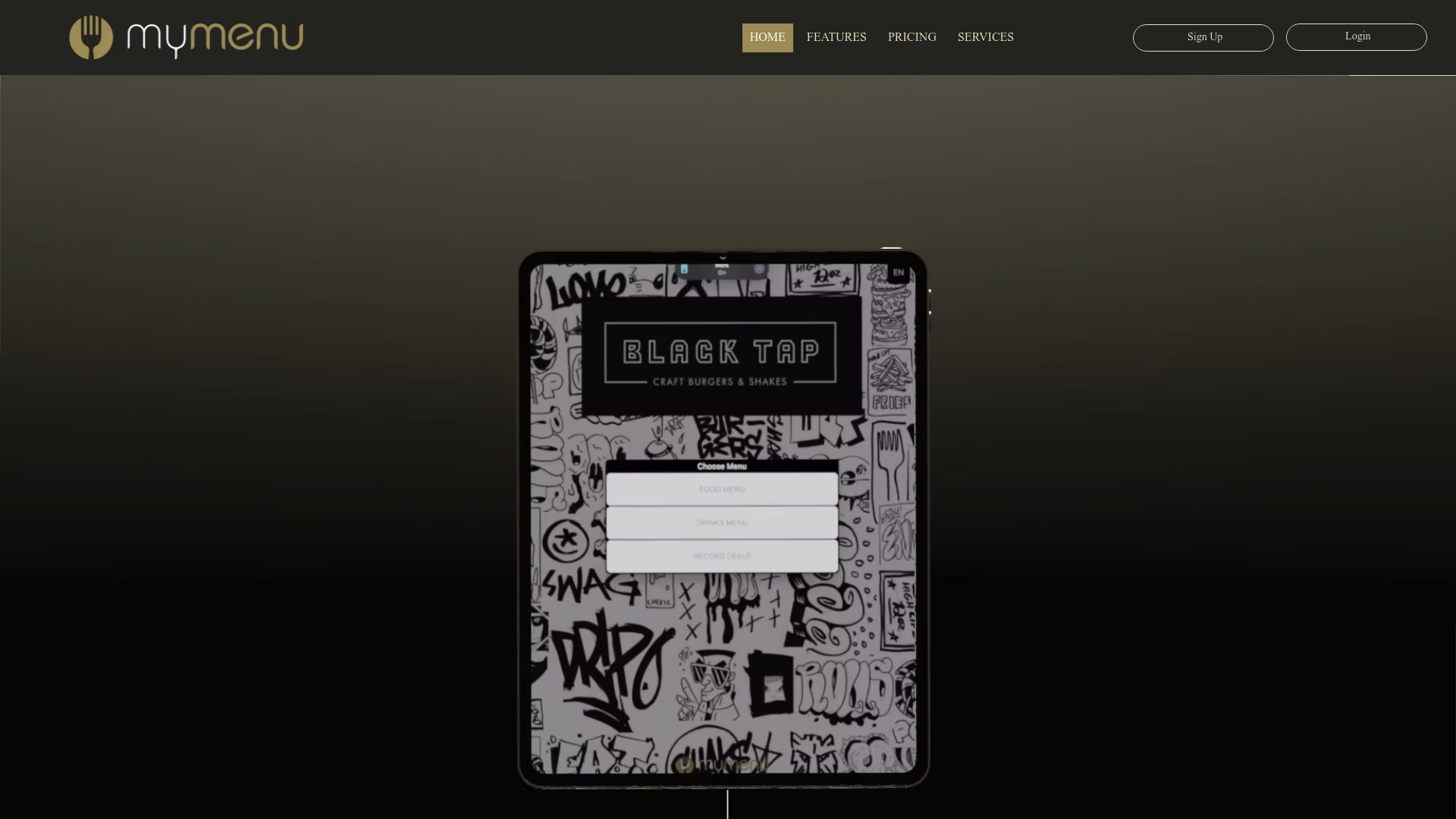
Mydigimenu was built from the ground up for restaurants, cafes, bars, and hotels — not adapted from a generic digital signage tool. Where most DSMenu substitutes focus on one layer of the guest experience, Mydigimenu covers the entire arc: from the moment a guest scans a QR code menu to the loyalty stamp they earn after paying with their preferred method, including cryptocurrency.
The platform’s feature set goes well beyond menu display. Mydigimenu supports tablet and mobile app menus with no app download required, high-quality food video presentations, customizable layouts, guest profile capture via social login, CRM integration, targeted marketing campaigns, digital stamp card loyalty programs, reservation management, and detailed nutritional information. It connects with third-party POS and delivery platforms, supports multiple languages and currencies, and gives multi-location operators centralized control over every screen and menu. You can boost guest engagement from day one without rebuilding your existing tech stack.
Ready to see how it fits your operation? Explore Mydigimenu’s plans and pricing and request a demo tailored to your venue type.
Key takeaways
The strongest DSMenu alternatives for hospitality managers in 2026 are platforms that combine native POS integration, flexible signage capabilities, and centralized multi-location control — with Mydigimenu offering the most complete hospitality-native feature set.
Point | Details |
Top alternatives identified | Fugo, OSM Solutions, Digital Menu Box, Eyeconic.TV, Push Operations, and Mydigimenu each serve different hospitality needs. |
POS integration is critical | Native POS connections update menus in real time; middleware layers introduce lag and manual error risk. |
Automated dayparting drives revenue | Automated pricing triggers tied to time of day correlate with measurable average ticket size improvements. |
Support quality shapes outcomes | Responsive onboarding assistance is a decisive factor in vendor selection, per user reviews. |
Mydigimenu covers the full experience | QR menus, CRM, loyalty programs, multimedia display, and multi-currency support make it the most hospitality-native option. |
Recommended
A gaming website becomes more useful when it answers the questions visitors actually have. People may want to know about supported devices, account requirements, gameplay instructions, or available support options. Providing this 9k club information in an organized format saves time and reduces confusion. I appreciate straightforward explanations that avoid unnecessary technical language. Clear communication helps beginners understand what they are exploring and allows experienced users to locate specific details without reading through information that is unrelated to their needs.
I usually prefer understanding the basic instructions before exploring all the features of a new game. This https://raxigamea.com/ helps me become familiar with the controls and prevents unnecessary confusion during the first session. Clear tutorials can make a big difference, particularly for people who have little experience with a particular type of game. This post is a useful starting point for beginners who want to learn more. More step-by-step guides with practical examples would make gaming websites even more helpful for their readers.
I found this post helpful because it answers many basic questions in a simple way. The information is clearly explained, and the overall writing is easy to understand. It gave me some useful knowledge that I can keep in mind later.
https://92blazegamez.com.pk/
Sometimes the most rewarding gaming experience starts with choosing a title you have never played before. Trending Games can open the door to new challenges, fresh mechanics, and memorable moments, giving players plenty of reasons to explore beyond their usual favorites.