
Table management: Boost restaurant efficiency and guest experience

TL;DR:
Effective table management optimizes guest flow, turnover, and revenue, beyond just filling seats fast.
Digital tools enhance speed, data tracking, and guest experience, leading to operational efficiency.
Proper scheduling, flexible layouts, and staff training are key to maintaining smooth, profitable service.
A packed dining room feels like success, but it can quietly become your biggest liability. When tables sit idle between guests, when orders crawl out of the kitchen, or when your floor plan fails to flex during a Friday rush, every wasted minute translates directly into lost revenue and frustrated diners. Effective table management is not simply about filling every seat as fast as possible. It’s about choreographing every element of the dining experience, from the moment a guest walks in to the moment a freshly reset table is ready for the next party, so that efficiency and hospitality move in perfect harmony.
Table of Contents
Key Takeaways
Point | Details |
Define table management | Table management means coordinating every aspect of guest seating and service for efficiency and satisfaction. |
Track turn times | Using benchmarks like 3-4 turnovers per period helps maximize covers and revenue. |
Leverage digital tools | Apps and contactless ordering systems dramatically streamline operations and reduce errors. |
Space reservations smartly | Interval scheduling spreads guest arrivals and avoids service bottlenecks. |
Blend tech with service | True table management success means combining digital systems with trained, attentive staff. |
What is table management?
Table management is the practice of strategically coordinating how tables are assigned, occupied, served, and turned over during a service period. It goes well beyond having a host point guests to an open seat. True table management weaves together seating logic, server assignments, order timing, and guest communication into a seamless operational flow.
At its core, table management encompasses four major activities:
Seating: Matching the right party size to the right table while anticipating upcoming arrivals
Tracking: Monitoring the real-time status of every table from occupied to waiting for dessert
Turning: Moving guests efficiently through their dining journey without ever making them feel rushed
Resetting: Clearing, cleaning, and preparing a table rapidly so the next guest experiences a pristine setup
A common misconception among operators is that more tables always means more profit. In reality, a restaurant with 20 well-managed tables can easily outperform one with 35 chaotically run tables. Revenue is a product of efficiency, not raw capacity.
“The real measure of a restaurant’s table management is not how many tables it has, but how smoothly each table moves through the full cycle of service.”
Turn time tracking and reservation interval spacing are recognized as core methodologies that define successful table management. When you track turn times, you gain clear visibility into where your service cycle slows down, whether at the ordering stage, the check presentation, or the reset. That visibility is what transforms guesswork into actionable improvement.
Investing in digital table ordering can fundamentally accelerate this cycle, giving both guests and staff the tools they need to move faster without sacrificing the warmth of genuine hospitality.
Essential elements of effective table management
Now that we know what table management is, it’s time to see how each piece fits into a successful operation. The gap between a restaurant that constantly scrambles during peak hours and one that glides through a full house often comes down to a handful of well-executed fundamentals.
Here are the five critical elements every operator needs to master:
Turn time tracking: Measure the elapsed time from when a party is seated to when the table is fully cleared and reset. This single metric reveals more about your operational health than almost any other.
Flexible floor plans: Design your dining room to adapt quickly. Prioritizing smaller tables that can be pushed together for larger parties gives you far more revenue-generating options during high-volume shifts.
Reservation interval spacing: Avoid the trap of booking every reservation on the hour. Staggered arrivals prevent an all-at-once rush that overwhelms your host stand, kitchen, and servers simultaneously.
Ordering speed: The faster guests can browse and place their order, the sooner the kitchen can start. Every minute saved here accelerates the entire service cycle.
Table resets: A slow reset is an invisible revenue killer. Disciplined, rapid reset routines keep your floor moving even during the busiest periods.
Turnover benchmarks worth knowing
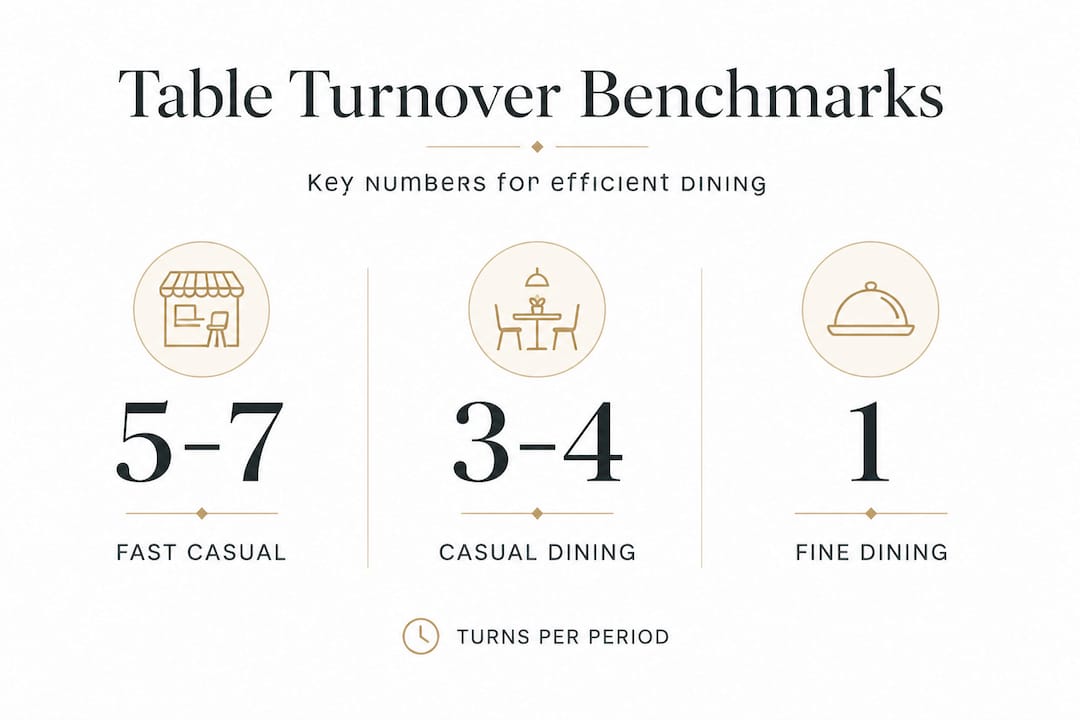
The right turnover rate depends on your dining concept. Casual dining targets 3 to 4 turnovers per meal period, while fine dining typically aims for a single, carefully curated turnover. These benchmarks are not suggestions. They are the difference between hitting your revenue targets and falling short.
Dining concept | Target turnovers per period | Typical turn time |
Fast casual | 5 to 7 | 20 to 30 minutes |
Casual dining | 3 to 4 | 45 to 60 minutes |
Upscale casual | 2 to 3 | 60 to 90 minutes |
Fine dining | 1 | 90 to 120 minutes |
With reservation and table management systems built for modern restaurants, tracking these benchmarks in real time is no longer reserved for large chains with deep technology budgets. Even independent operators can leverage intuitive platforms to monitor table status, measure turn times, and make smarter seating decisions on the fly.
Pro Tip: When your dining room is at high volume, break up larger tables into smaller configurations. Two two-tops generate more revenue potential than one four-top sitting half-empty, and they give you greater flexibility to accommodate walk-ins alongside reservations.
Improving online reservation efficiency is equally important. When guests book online and receive confirmed time slots, the unpredictability of walk-in rushes becomes far more manageable for your entire team.
How digital solutions are revolutionizing table management
While traditional techniques build the foundation, technology has opened new horizons for table management. The arrival of reservation apps, contactless ordering platforms, and real-time floor management tools has shifted what’s possible for restaurants of every size and style.
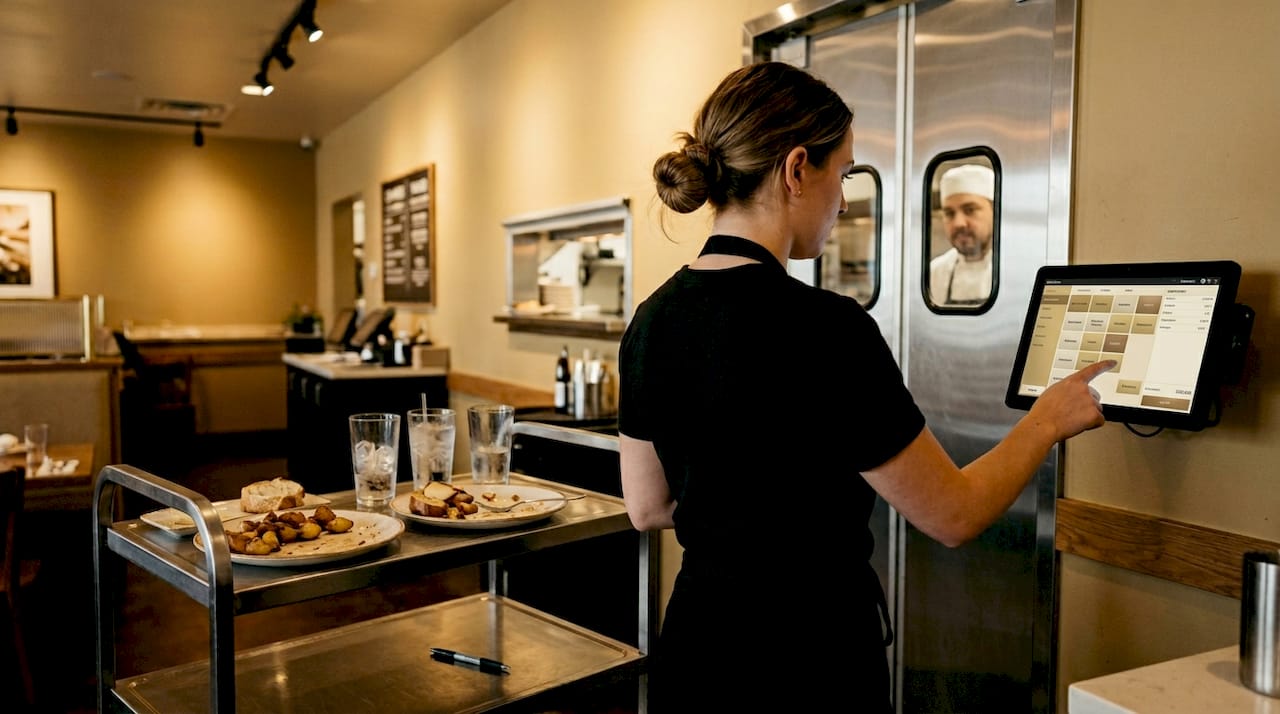
The most tangible improvements come from two areas: speed and data. Digital ordering systems eliminate the back-and-forth of a server writing down orders by hand, reducing errors and shaving precious minutes from the ordering cycle. Contactless menus let guests browse at their own pace, ask questions digitally, and place their order the moment they’re ready, without waiting for a server to circle back.
Consider these measurable advantages that operators consistently report after adopting digital tools:
Shorter ordering times: Guests who order through a QR menu place their first order faster because the menu is always in front of them
Faster table resets: When payment is processed digitally at the table, the check-and-go cycle accelerates dramatically
Better guest feedback: Digital platforms capture real-time satisfaction data, letting managers address issues before they become negative reviews
Smarter floor management: Visual dashboards show which tables are occupied, which are nearly done, and which are ready to seat, all at a glance
The numbers speak clearly. Prompt ordering under three minutes in casual dining, combined with table resets completed in under four minutes, delivers the kind of operational efficiency that directly boosts revenue per seat per shift.
Statistic spotlight: When a 60-seat casual restaurant achieves even one additional table turn per shift by cutting two minutes off its average order time and three minutes off its reset time, that single improvement can add tens of thousands of dollars to annual revenue.
Feature | Traditional approach | Digital approach |
Menu browsing | Physical menu, server-dependent | QR code, instant access |
Order placement | Server writes, re-reads, submits | Guest selects, auto-sent to kitchen |
Payment | Wait for check, card back-and-forth | Digital payment at table |
Guest feedback | Comment cards rarely completed | Instant digital prompts, high response |
Table status tracking | Visual walk-around by manager | Real-time dashboard update |
Digital ordering systems do more than speed things up. They create a richer guest experience by presenting beautiful food photography, detailed descriptions, allergen information, and even promotional upsells, all without a single word from a server. This means your team can focus their energy on genuine hospitality rather than reciting menu details.
For restaurants exploring broader online ordering systems, the integration of in-dining and off-premise ordering into one platform creates a unified operational picture that simplifies everything from inventory tracking to guest communication.
Practical steps to optimize your table management
With the tools and strategies explained, let’s break down a practical roadmap you can use right away. Improving table management doesn’t require a complete overhaul of your operation. Often, targeted changes in a few key areas produce immediate, visible results.
Audit your current turn times. Spend two or three service periods simply measuring how long each stage of the dining cycle takes. You cannot improve what you don’t measure, and you’ll likely discover one or two bottlenecks that account for most of your delays.
Redesign your floor plan with flexibility in mind. Flexible floor plans prioritizing small tables for high-volume shifts, combined with reservation interval spacing in 15 to 30 minute blocks, smooth guest flow and prevent the dreaded all-at-once arrival surge.
Implement staggered reservation intervals. Book reservations every 15 to 30 minutes rather than in full-hour blocks. This single change alone can reduce host stand chaos and give your kitchen a more manageable rhythm throughout the shift.
Train your team on reset protocols. Establish a clear, timed reset routine and practice it. Every staff member should know exactly what needs to happen in the four minutes between one guest leaving and the next being seated.
Introduce digital ordering tools. Even if you start with a simple QR code menu, the effect on ordering speed and guest engagement is immediate. Explore reservation management methods that integrate with your existing systems to get the most out of your technology investment.
Review and adjust weekly. Table management is not a set-it-and-forget-it process. Review your turn time data weekly, identify recurring issues, and adjust your floor plan, staffing, or booking intervals accordingly.
Common pitfalls to actively avoid include overbooking, which leads to guests waiting beyond their reservation time and damages trust; neglecting reset speed, which creates visible idle tables during busy periods; and treating all time slots equally, when the reality is that your 7:00 PM Saturday slot needs far more support than a Tuesday lunch booking.
Pro Tip: Study reservation best practices to build booking policies that protect your floor plan from the avalanche effect of multiple large parties arriving simultaneously.
A modern perspective on table management: What most guides miss
Most articles on table management focus on the mechanics. Turn the table faster. Space your reservations. Use a floor plan tool. The advice is sound, but it sidesteps the most important insight: efficiency without experience is just speed, and speed without hospitality is just noise.
The operators who achieve lasting success with digital table management are not simply the ones who install the best software. They’re the ones who recognize that technology is a bridge, not a destination. A QR code menu that loads slowly or a reservation system your host can’t navigate under pressure will create more friction than it removes.
Real-world digital conversions teach a humbling lesson. Restaurants that adopt new tools without investing in staff training often see temporary improvements followed by a regression to old habits. The technology sits unused or underused while the team defaults to familiar workarounds. This is not a technology failure. It’s a change management failure.
Optimizing reservation workflows is one area where the gap between potential and reality is especially wide. A smart reservation system can predict no-shows, suggest optimal seating configurations, and send automated reminders to guests. But if your host team doesn’t understand how to interpret and act on that data, the system’s power goes untapped.
The uncomfortable truth is that guest experience and operational efficiency are not competing priorities. They are deeply interdependent. A guest who feels rushed because your team is chasing turnover metrics will not return. A guest who waits 45 minutes to be seated at a half-empty restaurant will not return either. The sweet spot lies in creating a rhythm where tables move smoothly, guests feel valued, and your team operates with confidence rather than chaos.
Test your digital tools during lower-volume shifts first. Train staff in small groups. Gather guest feedback actively and treat it as operational data, not just a feelings report. Adapt your approach based on what you learn, not just what the software dashboard tells you. That blend of technology, training, and genuine hospitality is what separates the restaurants guests remember from the ones they forget.
Take your table management further with My Menu
Having highlighted the key strategies and digital trends shaping modern restaurants, the natural next step is exploring tools built specifically to bring these ideas to life in your dining room.
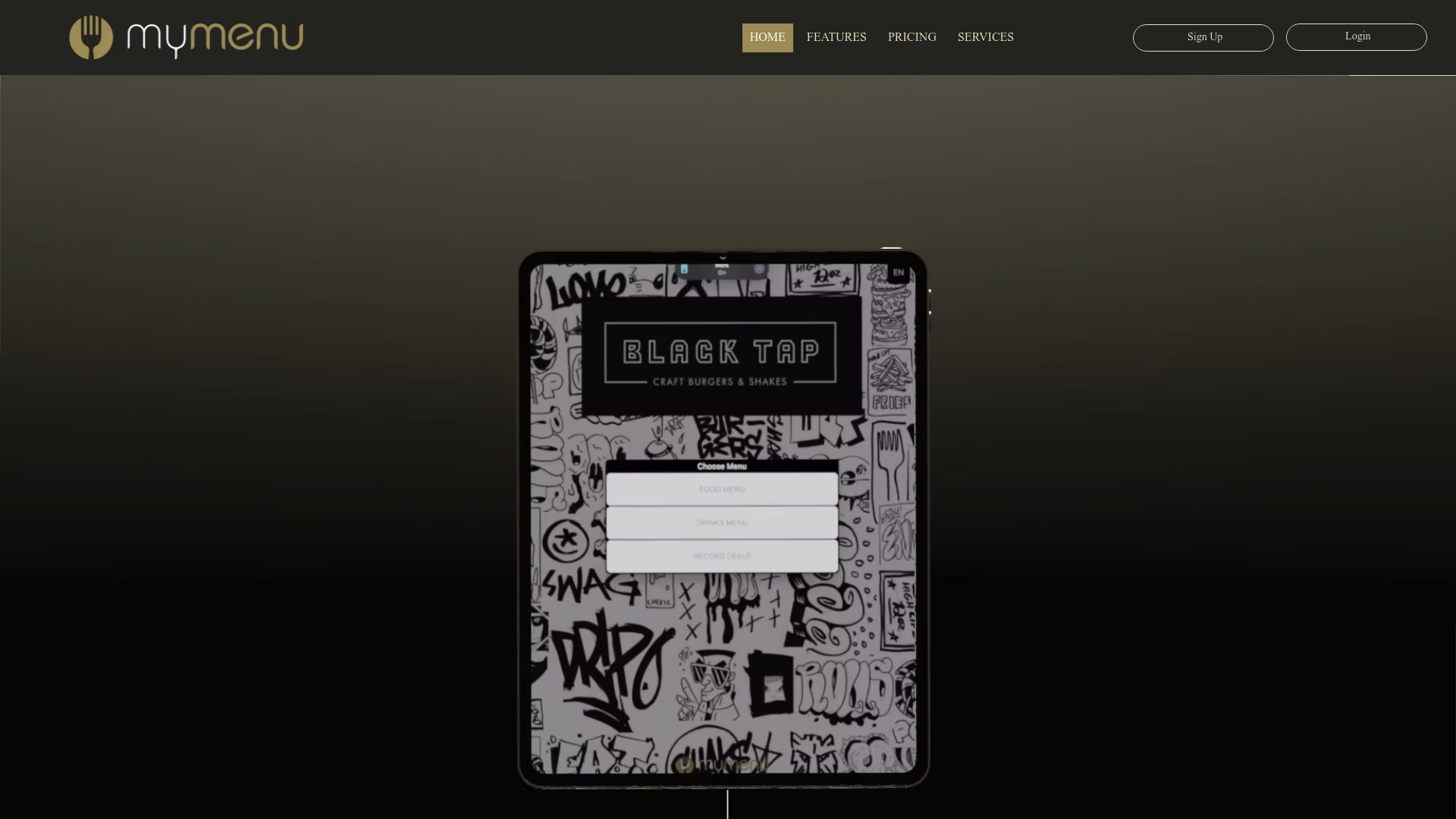
MyDigiMenu.com offers a full suite of digital menu solutions designed to accelerate ordering, elevate your guest experience, and empower your team with real-time management capabilities. From beautifully presented QR menu features that require no app download to robust reservation and floor management tools, the platform is built for restaurants that want operational efficiency and memorable hospitality to coexist. Explore flexible options at My Menu pricing and discover how a smarter digital foundation can transform your table management from a daily challenge into a genuine competitive advantage.
Frequently asked questions
What is table management in a restaurant?
Table management involves efficiently coordinating seating, orders, and turnovers to maximize revenue and guest satisfaction, using core methods such as turn time tracking and interval spacing to keep service flowing smoothly.
How does digital table management improve efficiency?
Digital systems automate bookings, track table status in real time, and speed up order processes, with prompt ordering under three minutes and resets under four minutes delivering the strongest efficiency gains.
What is a good table turnover rate?
Three to four turnovers per meal period is the benchmark for casual dining, while fine dining typically targets a single, well-paced turnover per service period.
What are common table management mistakes?
Overbooking, slow resets, and rigid floor plans are the most frequent errors, as flexible floor plans and staggered reservations in 15 to 30 minute blocks are essential to avoiding costly bottlenecks.
How does reservation spacing help table management?
Spacing reservations every 15 to 30 minutes distributes guest arrivals evenly throughout the shift, and reservation interval spacing prevents the simultaneous surge that overwhelms hosts, servers, and kitchen staff during peak periods.
Recommended
Comments